
Practical checklist for retirees to assemble pension proof for Spain's Non‑Lucrative Visa. Apostille before translation, match names, and meet 400% IPREM...
400% IPREM: How Retirees File Pension Proof for Spain’s NLV

Spanish consulates accept two things as pension proof for the Non-Lucrative Visa: an official pension award letter and bank statements showing that pension actually landing in your account, month after month. The financial bar is set at 400% of the IPREM index, roughly $28,800 to $31,000 a year depending on the exchange rate, for a single applicant. Every foreign document needs an apostille and a certified Spanish translation before a consular officer will look at it twice.
TL;DR:
- Applicants must provide both an official pension award letter and bank statements showing monthly deposits for at least three months to prove recurring, legitimate income.
- Documents require an apostille from the relevant authority and must be translated by a certified Spanish sworn translator in the correct sequence to avoid delays.
- The income threshold is roughly $28,800 to $31,000 annually for a single applicant, with additional amounts per dependent, adjusted by the exchange rate and current IPREM value.
- Consulates evaluate net deposits rather than gross figures and prefer full year deposit histories to verify income stability before approval.
- Proper file organization, consistent naming, and compliance with local consulate requirements significantly increase approval chances, making professional review advantageous for complex or borderline cases.
Table of Contents
- What Documents Count as Pension Proof for a Spain Visa?
- How Do You Format and Authenticate Pension Evidence?
- How Much Income Do You Need to Show for the Visa?
- What Happens After You Submit: Steps and Timeline
- Why Do Consulates Deny Pension Proof, and How Do You Fix It?
- How a Visa Consultant Reviews a Pension File
- Which Types of Pensions Do Spanish Consulates Recognize?
- How Do You Get and Authenticate Pension Documents From Different Countries?
- What Health Insurance Do You Need Alongside Pension Proof?
- Does the Consulate Look at Gross or Net Pension Income?
- What if Your Pension Proof Is Borderline?
- How Do Requirements Differ Across Spanish Consulates?
- The File That Gets Approved Isn’t the One With the Most Money
- Let Digital Nomad in Spain Handle Your Pension File
- Where to Find Official Forms and Authentication Resources
- Sources
- FAQ
What Documents Count as Pension Proof for a Spain Visa?
Consulates want a paper trail that starts at the source of your money and ends at your bank account. That means pairing an official award document with real deposit history, not submitting one and hoping it covers for the other.
Pension award letters sit at the top of the list. If you draw Social Security, your annual SSA benefit verification letter (sometimes called a budget letter) states your monthly amount and confirms it’s ongoing. Private pension holders need the equivalent certificate from the plan administrator, showing the same details: payer, amount, frequency, and duration.
Bank statements back up the letter with proof the money actually shows up. Consular guidance generally wants three months minimum, though a full 12-month deposit history is far stronger, especially for officers who see thousands of these applications and know exactly what a fabricated one looks like. Highlight or annotate the recurring deposits so the reviewer doesn’t have to hunt for them across pages of unrelated transactions.
Beyond the core combination of pension letter plus deposits, consulates commonly accept a mix of supplementary income evidence:
- Annuity statements showing guaranteed periodic payouts
- IRA or 401(k) distribution records, particularly required minimum distributions that show a pattern
- Rental income backed by a lease and deposit records
- Dividend or investment income with brokerage statements covering several quarters
- Combined award letters and bank records for applicants drawing from more than one pension source
If your income comes from several places, that’s fine. Consulates don’t require a single monolithic pension. Immigration guides on retirement visas note that combined evidence — Social Security plus a private pension plus rental income — is routine, as long as each stream has its own supporting document and the total clears the threshold.
The mistake most applicants make is treating these documents as interchangeable when they’re not. A pension letter proves the source is legitimate and ongoing. Bank statements prove the money is real and recurring. You need both, and they need to agree with each other on names, amounts, and dates. A one-page cover summary that lists each income source and points to its evidence, discussed in the next section, is what turns a stack of paper into a file an officer can approve in one sitting.
Pro Tip: If you’re drawing from a 401(k) or IRA, request a distribution schedule from your plan administrator rather than relying on account statements alone. Consular officers sometimes flag lump-sum-looking withdrawals as savings rather than income, and a schedule proves it’s structured, recurring pension-style income.
How Do You Format and Authenticate Pension Evidence?
Getting the right documents is only half the job. Spanish consulates reject strong financial files constantly, not because the applicant lacked money, but because the paperwork didn’t match itself or wasn’t legalized correctly.
Apostille versus legalization trips up more applicants than any other step. An apostille is the standard authentication for documents used between countries that signed the Hague Apostille Convention, which includes both the United States and Spain. Any U.S.-issued document going into your visa file, an FBI background check, a state-issued pension certificate, needs this stamp before translation. The U.S. Department of State’s Office of Authentications handles federal-level documents, while state-issued records typically route through your state’s Secretary of State office first.
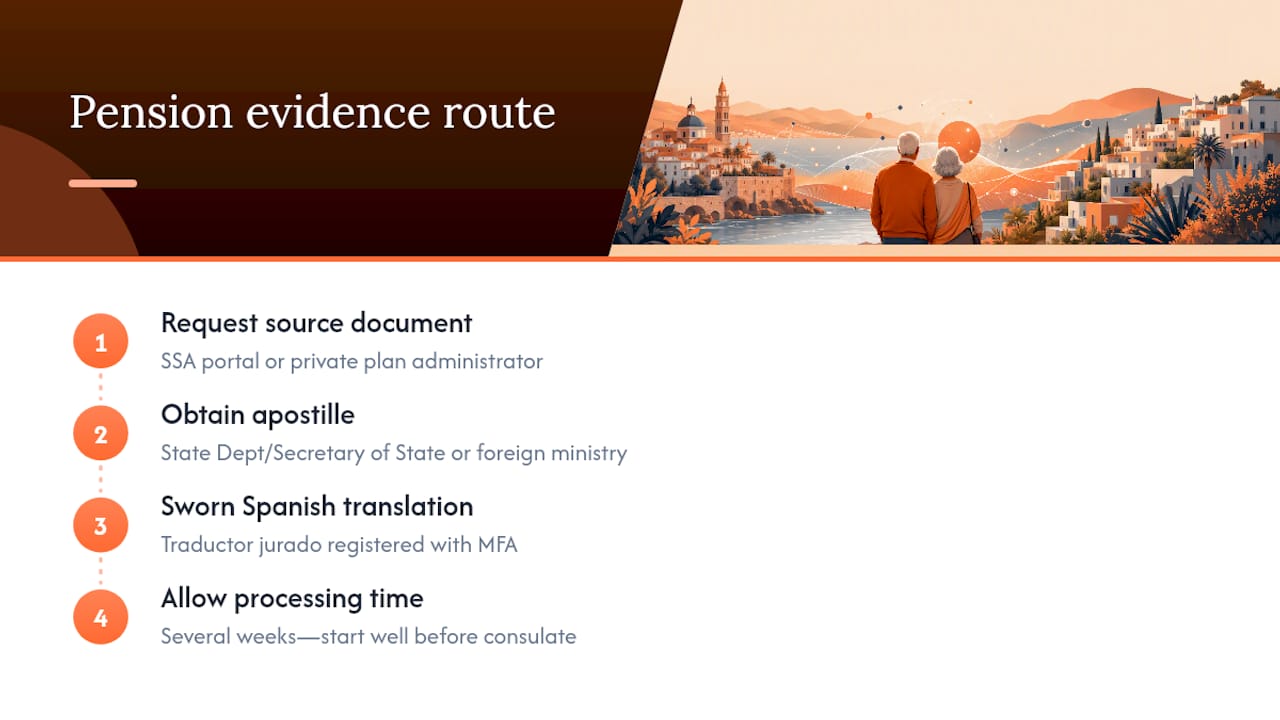
Certified Spanish translation comes after the apostille, never before. A sworn translator (traductor jurado) registered with the Spanish Ministry of Foreign Affairs must translate the document once it’s fully authenticated. Translating first and apostilling second is a common, easily avoidable error that adds weeks to your timeline.
Here’s the sequence that avoids rework:
- Obtain the original pension letter or certificate from the issuing agency
- Apostille it through the appropriate state or federal authority
- Send the apostilled original to a certified Spanish translator
- Attach the translation directly behind the original document, never as a separate section
- Cross-check every name, account number, and dollar figure against your bank statements
Name matching deserves its own scrutiny. If your pension letter reads “Robert J. Smith” and your bank account reads “Bob Smith,” that inconsistency alone can stall a file. Fix it before submission with a name-change affidavit or a bank letter confirming the accounts belong to the same person, rather than letting the consulate discover it and issue a request for more information.
Finish with a one-page index that lists each income source, its monthly amount, and the page number where its evidence sits. Consular officers process hundreds of these applications. A file that reads clearly on the first pass moves faster than one that makes them dig.
Pro Tip: Number every page of your financial file by hand before submission, and reference those numbers in your cover index. It sounds basic, but it’s the single easiest way to make a 40-page file feel organized instead of overwhelming to whoever reviews it.
How Much Income Do You Need to Show for the Visa?
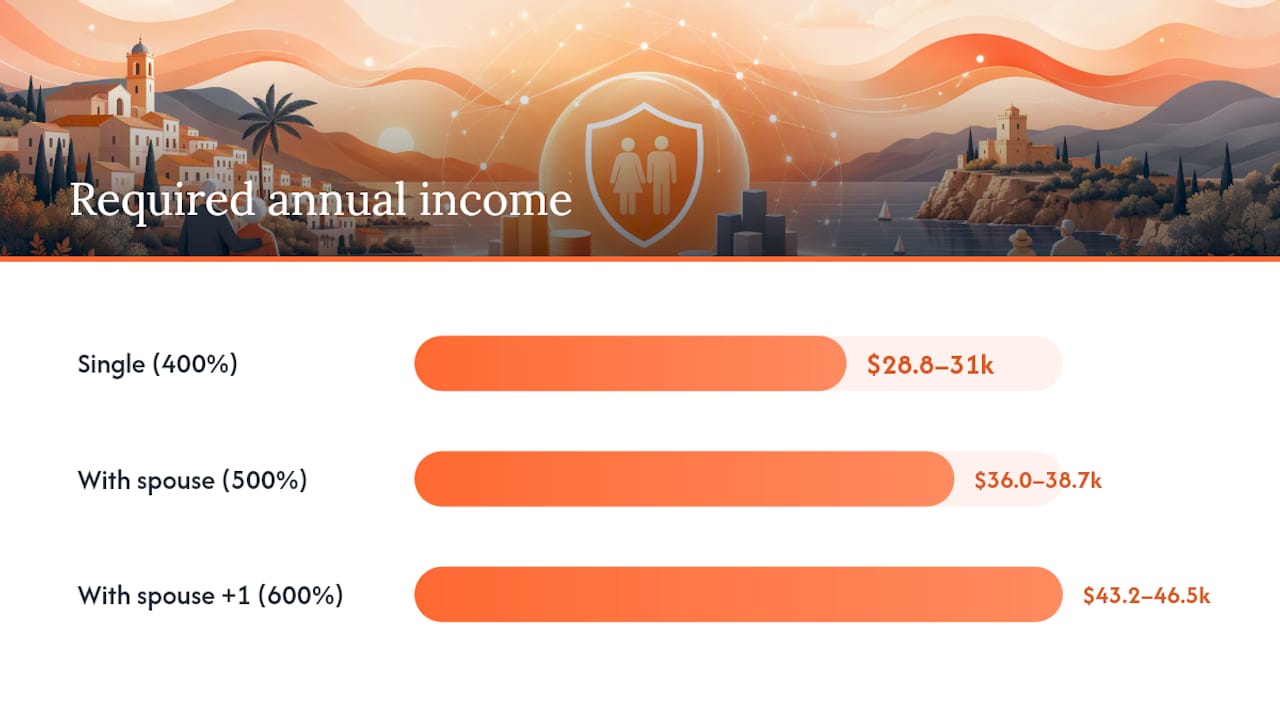
For the main applicant, that works out to roughly $28,800 to $31,000 annually, depending on where the dollar sits against the euro at the time you apply. Because IPREM is set in euros and updated annually by the Spanish government, the dollar figure moves with the exchange rate, not with your consulate’s mood.
Each dependent adds 100% of IPREM to that baseline. Rough annual figures look like this:
- Single applicant: 400% IPREM, about $28,800 to $31,000
- Applicant plus spouse: 500% IPREM, about $36,000 to $38,700
- Applicant plus spouse and one child: 600% IPREM, about $43,200 to $46,500
Those dollar ranges shift year to year, so confirm the current IPREM figure with your consulate before you calculate your own numbers, and never assume last year’s conversion still holds.
If your recurring pension falls short of the threshold, savings can fill the gap. Consulates generally want proof you can sustain the required amount for the full first year, which usually means demonstrating either the annual income figure through recurring payments or an equivalent lump sum sitting in a verifiable account. A retiree with a $22,000 pension and a documented $9,000 in savings, for instance, can often make the combined case work, provided both pieces are backed by clean paperwork.
Applicants who combine a modest pension with retirement-account withdrawals or savings tend to strengthen otherwise borderline files, according to guidance from immigration specialists tracking NLV requirements.
Whichever path you take, present your numbers conservatively. Consulates would rather see a clean $30,000 with three months of clear deposit history than a padded $45,000 built on one irregular transfer. Twelve months of statements beats three every time it’s available, since it shows the pension is a pattern, not a coincidence.
What Happens After You Submit: Steps and Timeline
Getting the financial file right is most of the battle, but the consular process has its own rhythm, and skipping a step out of order costs real weeks.
- Gather background documents early. Request your FBI Identity History Summary check and medical certificate first, since both take time and both need apostilles before translation.
- Apostille and translate everything foreign-issued, from the FBI check to pension letters, following the sequence covered earlier.
- Book your consulate appointment through the MAEC appointment portal, which manages scheduling for most U.S.-based Spanish consulates. Slots fill fast in some jurisdictions, so book as soon as your documents are apostilled, even before translations are finished.
- Attend the interview with originals, copies, and your organized index. Officers generally review the file on the spot and may ask clarifying questions about income sources.
- Wait for processing. Most consulates process Non-Lucrative applications within a couple of months, though timing varies by jurisdiction and season, with spring and summer applications often taking longer due to volume.
- Enter Spain within 90 days of visa issuance. The visa itself is a travel document, not your residency card.
- Apply for your TIE card within 30 days of arrival at the local immigration office, which converts your visa into an actual residency card tied to your local address.
Requirements and processing speed differ by consular district, so confirm current expectations with the specific consulate handling your jurisdiction before finalizing your calendar.
Why Do Consulates Deny Pension Proof, and How Do You Fix It?
Most denials trace back to the same handful of avoidable problems, and nearly all of them are fixable before you ever sit down for your interview.
- Mismatched names between documents. A pension letter, bank account, and passport that don’t read identically raise flags immediately. Fix it with a notarized name-affidavit or a bank letter confirming account ownership under all name variants.
- Insufficient deposit history. Three months of statements is the legal floor, but a single deposit or an irregular pattern reads as unreliable. Pull a full 12 months whenever your bank allows it.
- Missing or improperly ordered apostilles. Translating before apostilling is the most common version of this error. Redo the sequence: apostille first, sworn translation second.
- Health insurance gaps. Spain’s NLV requires a private policy with full coverage and no copays for the first year. A policy with deductibles or partial coverage gets flagged, so confirm your insurer explicitly meets consular requirements before submission.
- Non-recurring or lump-sum withdrawals mistaken for savings. If your retirement account distributions look like a one-time transfer rather than a structured payout, attach a distribution schedule from the plan administrator.
Pro Tip: Before your appointment, lay every document side by side and read them the way a stranger would: does the name match everywhere, does the math add up across every page, and does the dollar figure on your cover index match what’s actually in the bank statements? Officers catch inconsistencies fast because they’re trained to look for exactly this.
How a Visa Consultant Reviews a Pension File
An experienced reviewer starts in the same place every time: does the pension letter’s monthly figure match the deposits in the bank statements, and do the names on both documents agree? That single cross-check catches the majority of red flags before a file ever reaches a consulate.
Preparation focuses on coordinating apostilles and sworn translations in the correct order and matching every deposit line to its corresponding pension letter before submission, closing the gaps that typically trigger a request for more information.
Retirees with a single, clean pension source and strong deposit history often manage a DIY submission successfully. Where professional review earns its cost is with mixed income, multiple pension sources, rental income, retirement account withdrawals, since that’s exactly where inconsistencies tend to hide.
Which Types of Pensions Do Spanish Consulates Recognize?
Spanish consulates don’t discriminate by pension type. They care about three things: is it official, is it recurring, and is it documented. That said, the mix of evidence differs by source.
State pensions, Social Security in the U.S. case, come with a standardized benefit verification letter that consulates recognize on sight, since they see it constantly. This is generally the cleanest form of pension proof available to American applicants.
Private pensions, whether from a former employer’s defined-benefit plan or a purchased annuity, require a certificate from the plan administrator stating the payout amount, frequency, and duration. These carry equal weight to state pensions, provided the issuing institution is verifiable and the certificate is properly apostilled and translated.
Foreign pensions, meaning a pension earned in a third country other than the U.S. or Spain, follow the same apostille and translation rules but may need an additional step: proof the issuing country’s pension system is legitimate and the payments are guaranteed rather than discretionary. This is where dual-national retirees or those who worked abroad sometimes hit friction, and where extra supporting documentation from the foreign pension authority helps close the gap.
In every case, the underlying test is the same: can the consulate verify the money is real, is guaranteed, and will keep arriving after you land in Spain.
How Do You Get and Authenticate Pension Documents From Different Countries?
The process shifts depending on where your pension originates, but the endpoint is always the same: an apostilled, translated document a Spanish consulate can trust.
For U.S.-sourced pensions, request your Social Security benefit letter directly through the Social Security Administration’s online portal, or contact your private plan administrator for a certified benefit statement. Federal documents route through the State Department’s Office of Authentications for apostille, while state-issued records go through your state’s Secretary of State first.
For pensions from other countries, the apostille authority is whichever government agency your home country designates, typically a foreign ministry or equivalent judicial office. Hague Convention member countries all use the apostille system, so the process mirrors the U.S. steps even if the specific office differs.
Once apostilled, every document needs translation by a Spanish sworn translator (traductor jurado), regardless of its country of origin. Translators registered with Spain’s Ministry of Foreign Affairs carry official recognition that generic certified translators don’t, and consulates specifically look for that credential on the translation’s seal.
Give yourself more runway than you think you need. Apostille processing alone can take several weeks depending on the issuing office, and sworn translation adds more time on top. Starting this process only after your consulate appointment is booked is one of the most common self-inflicted delays applicants create.
What Health Insurance Do You Need Alongside Pension Proof?
Pension proof gets you halfway. Spain’s Non-Lucrative Visa also requires a private health insurance policy that meets specific consular standards, and a policy that falls short here can sink an otherwise strong application.
The policy must provide full coverage with no copayments for at least the first year of residency. A plan with deductibles, coinsurance, or partial coverage for major procedures generally does not satisfy consular requirements, even if it would pass as adequate coverage in the U.S. The insurer also needs to be authorized to operate in Spain, meaning a U.S.-based travel insurance plan usually will not qualify no matter how comprehensive it looks on paper.
Consulate-approved policy providers typically issue a specific certificate confirming the plan meets NLV requirements, and that certificate should go into your file alongside your financial documents, not as an afterthought submitted separately. Consulates want to see the insurance certificate presented with the same care as your pension evidence, since a mismatch between your stated arrival date and your policy’s start date is its own denial trigger.
Buy the policy only after confirming NLV compliance explicitly with the provider. Generic international health insurance, even expensive comprehensive plans, frequently lacks the specific consular certification Spanish immigration officers are trained to look for.
Does the Consulate Look at Gross or Net Pension Income?
Consulates generally evaluate the income you actually receive, meaning net deposits landing in your account, rather than a gross figure quoted on paper before taxes or deductions. This distinction matters more than most applicants realize.
Submitting the gross number and hoping nobody checks the math is a common and easily caught mistake, since the bank statements sitting right behind the letter tell the real story.
For retirees drawing from multiple sources, gross-versus-net gets more complicated. A private pension might be paid gross with taxes handled separately, while Social Security arrives net of any applicable withholding. Add up the actual dollars hitting your account across all sources, not the sum of stated gross figures, and use that total against the threshold.
This is also where the difference between recurring income and one-time distributions matters. A required minimum distribution from an IRA counted once as a lump sum doesn’t carry the same weight as the same amount spread across twelve monthly withdrawals. Consulates are evaluating whether the income will keep arriving, not just whether it arrived once. When your net recurring income sits close to the threshold, structuring withdrawals to look consistent, and documenting that consistency with a distribution schedule, strengthens the file considerably.
What if Your Pension Proof Is Borderline?
Brokerage statements, rental agreements, or dividend records used as supplementary proof still need certified Spanish translation if they contain financial terminology or legal language a consular officer needs to interpret precisely. Simple account summaries in plain English sometimes pass without translation at the discretion of individual consulates, but relying on that discretion is a risk not worth taking when the alternative, getting it translated properly, costs relatively little.
Apostille rules apply the same way to supplementary documents as to your main pension letter. A rental income statement from a U.S. property management company still needs authentication if it’s being used as evidence of qualifying passive income, not just as color commentary in your application.
The safest approach when your pension is borderline: treat every supplementary document as if it were your primary evidence. Apostille it, translate it through a certified sworn translator, and cross-reference its figures against your bank statements exactly as you would for the pension letter itself. A detailed guide to sworn translation requirements walks through exactly which documents typically need this treatment and which consulates have shown more flexibility on the point.
When in doubt, over-document rather than under-document. A borderline file with excess supporting evidence reads as thorough. The same file with gaps reads as risky.
How Do Requirements Differ Across Spanish Consulates?
Spain doesn’t run its Non-Lucrative Visa through one centralized office. Each consulate operates somewhat independently within the framework set by MAEC’s national procedural guidelines, and that independence shows up in real differences applicants need to plan around.
Processing timelines vary meaningfully by jurisdiction, with some consulates clearing applications faster than others depending on staffing and application volume. Document formatting preferences differ too. Some consulates want originals stapled to translations in a specific order; others accept a bound packet with an index. Appointment availability is its own variable entirely, with some consular districts booking out much further than others depending on regional demand.
The safest move is treating your specific consulate’s published checklist as the final word, even when it conflicts slightly with general guidance you’ve read elsewhere. Consulate websites update their requirements periodically, and a rule that applied last year isn’t guaranteed to hold today. Before finalizing your file, check your consulate’s current page directly rather than relying solely on secondhand summaries, since the jurisdictional variation described in official MAEC guidance is real, not a formality.
The File That Gets Approved Isn’t the One With the Most Money
The applicants who sail through this process aren’t necessarily the wealthiest ones. They’re the ones whose paperwork tells one clean, consistent story from the first page to the last.
It doesn’t. A retiree with $45,000 in verified pension income and a name mismatch between their passport and bank account will get stuck in the same request-for-information loop as someone barely clearing the threshold. Consular officers aren’t auditors looking for maximum wealth. They’re reviewers looking for internal consistency across dozens of pages.
If there’s one thing worth prioritizing above all else, it’s the apostille-then-translate sequence and the name-matching check, both discussed earlier. They cost nothing but attention, and they’re responsible for more avoidable delays than any actual shortfall in income. Money problems are rare. Paperwork problems are common, and entirely within your control.
— Joshua
Let Digital Nomad in Spain Handle Your Pension File
Preparing pension proof yourself means learning apostille sequencing, sworn translation rules, and consular formatting preferences from scratch, usually while also packing up a household for a move overseas. Digitalnomadinspain exists so you don’t have to do both at once.

The firm’s document review process is built around exactly the failure points covered above: matching pension letters to bank deposits, sequencing apostilles correctly, and coordinating sworn Spanish translations so nothing arrives at the consulate out of order. The firm cites a high success rate and reports faster processing compared to typical self-filed cases, outcomes attributed to catching these formatting and sequencing issues before submission rather than after a denial letter arrives.
If your pension income is borderline, split across multiple sources, or foreign-earned, that’s precisely where professional review pays for itself. Start with a review of the Non-Lucrative Visa service page to see what document preparation and consulate follow-up support looks like, or check your standing first through the firm’s eligibility checker before booking a consultation.
Where to Find Official Forms and Authentication Resources
Start with the MAEC procedural portal for the current EX-01 application form and fee form 790-052, and use the MAEC appointment system to book and track your consulate visit.
For document authentication, the U.S. Department of State’s Office of Authentications handles apostilles for federal documents, and the FBI’s Identity History Summary service processes the background check most consulates require.
For NLV-compliant health coverage, consulate-approved insurance policies outline the full-coverage, no-copay features consulates specifically check for. For budgeting the overall process, a detailed cost breakdown covers typical fees beyond the visa application itself.
This article is general information, not a substitute for advice from a qualified lawyer. Consult a qualified legal professional about your own circumstances before acting on anything here.
Sources
- Non-working (Non-lucrative) residence visa
- MAEC procedural portal — Non‑Lucrative visa
- Office of Authentications — U.S. Department of State
- Spain Retirement Visa 2026: NLV for Retirees
FAQ
What Are Common Reasons for Spain Visa Denial?
The most frequent causes are mismatched names between financial documents, insufficient deposit history, apostilles obtained after translation instead of before, and health insurance policies that include copays or partial coverage.
What Are the New Residency Rules for Spain in 2026?
IPREM figures and specific documentation preferences are updated periodically and can vary by consular district, so confirm current thresholds and required forms directly with your specific consulate through the MAEC procedural portal before submitting.