Discover how to secure your Spain retirement visa in 2026. Learn the requirements, benefits, and step-by-step application process today!
The Spain retirement visa is officially called the Non-Lucrative Visa (NLV), a residency permit designed for financially self-sufficient non-EU citizens who want to live in Spain without working. Spanish immigration law grants this visa to retirees and passive income holders who can prove they will not need to earn money inside Spain. The NLV is issued initially for one year, then renewable for two-year periods, with a path to permanent residency after five continuous years. Understanding the full picture before you apply saves time, money, and frustration.
What are the income requirements for the Spain retirement visa?
The 2026 financial threshold is €28,800 per year for the main applicant, based on 400% of Spain’s IPREM indicator. Each dependent you add to the application requires an additional €7,200 per year. A couple applying together needs to demonstrate at least €36,000 in annual passive income.
Acceptable income sources include:
- Government pensions (Social Security, state pensions)
- Private pensions and IRA distributions
- Dividends and investment returns
- Rental income from property abroad
- Annuities and structured financial products
The Spanish consulate does not simply want to see a large bank balance. Consulates prefer 12 months of bank statements showing consistent monthly deposits. A lump sum sitting in an account without regular income evidence is frequently rejected. That distinction catches many applicants off guard.
If you do not have sufficient monthly income, some consulates accept savings as an alternative. A figure of approximately €115,200 in liquid savings has been cited as a benchmark, though individual consulates apply this differently. Always confirm the exact threshold with your specific consulate before relying on savings alone.

Pro Tip: Request a formal pension award letter from your pension provider that states the monthly or annual amount in writing. Consulates treat this as the strongest single piece of income evidence.
What health insurance coverage is required?
Full private health insurance is a non-negotiable condition of the NLV. The policy must cover all medical expenses in Spain with no co-payments or deductibles, and no waiting periods for pre-existing conditions. Spanish immigration uses the phrase “sin copagos” to describe this standard.
The most common reason retirees fail this requirement is buying a policy that looks comprehensive but includes co-payments. Many standard international health plans charge a small fee per doctor visit or per prescription. Those policies are rejected at the consulate. Only policies that cover 100% of costs from day one are accepted.
Age creates an additional challenge. Many insurers cap coverage at age 65 or 70 and decline applicants above those thresholds. ASSSA is one insurer widely recognized for accepting applicants of all ages with stable renewal terms. Caser and Sanitas also operate in Spain, though both may require health questionnaires that can affect eligibility for older retirees.
Key features your policy must include:
- Full medical expense coverage with zero co-payments
- No waiting periods for any condition
- Valid across all of Spain, not just one region
- Issued by an insurer authorized to operate in Spain
Pro Tip: Before purchasing a policy, send the insurer’s product summary to your Spanish consulate’s requirements page and confirm it meets their specific criteria. Consulates in different cities sometimes apply slightly different standards.
How does the Spain retirement visa application process work?
You apply for the NLV at the Spanish consulate in your country of legal residence, not in Spain. US citizens apply through the Spanish consulate covering their home state. UK citizens apply through the Spanish consulate in London or Edinburgh. Canadian citizens apply through the consulate in their province.
The step-by-step process looks like this:
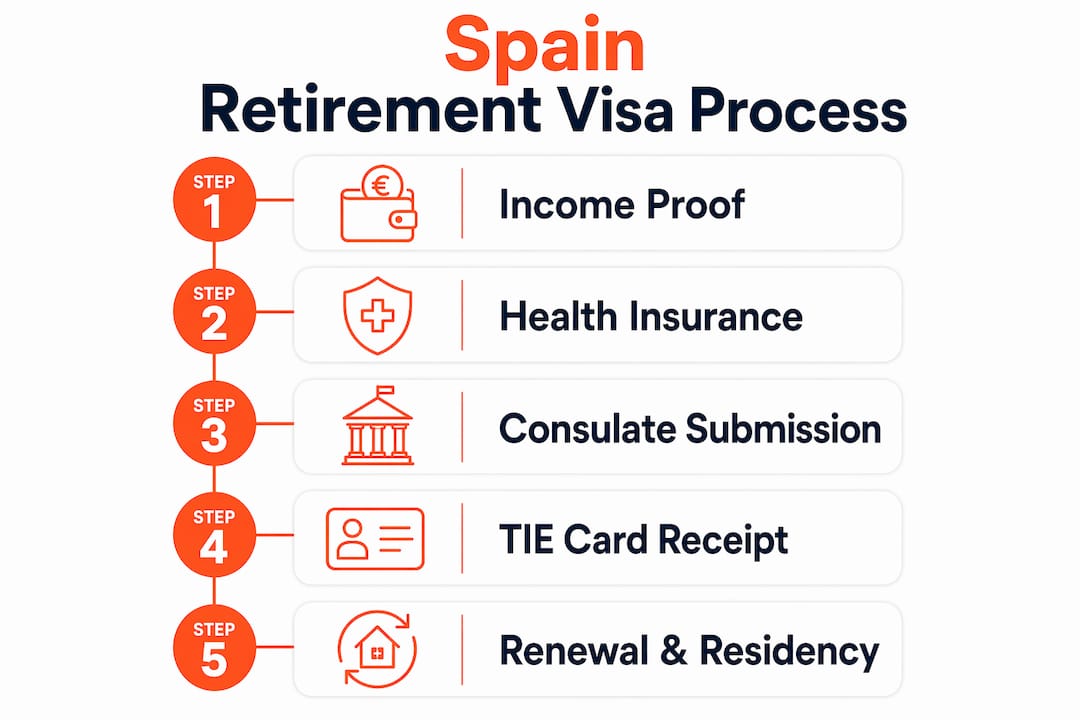
- Gather all required documents, including proof of income, health insurance, criminal record certificate, and passport photos.
- Have your criminal record certificate apostilled and sworn-translated into Spanish within three months of your appointment.
- Book a consulate appointment and submit your complete application in person.
- Wait for a decision. Processing typically takes 4 weeks to 3 months, depending on the consulate.
- Once approved, travel to Spain within the visa validity window.
- Register at your local town hall (empadronamiento) and apply for your TIE card (Tarjeta de Identidad de Extranjero) within 30 days of arrival.
The TIE card is your physical residency card and the document you will use for daily life in Spain. Losing it or letting it expire creates significant administrative problems, so treat the renewal calendar as a priority.
| Stage | Timeline |
|---|---|
| Consulate processing | 4 weeks to 3 months |
| Initial visa validity | 1 year |
| First renewal period | 2 years |
| Subsequent renewals | 2 years each |
| Permanent residency eligibility | After 5 continuous years |
| Citizenship eligibility | After 10 years (general rule) |
One documentation error ends more applications than any other factor. Expired police certificates or documents that are not properly apostilled are the leading cause of refusal. Every document from outside Spain must carry a valid apostille and a sworn Spanish translation.
What are the tax implications for the Spain retirement visa?
Spending 183 or more days in Spain in a calendar year makes you a Spanish tax resident. That status triggers an obligation to pay Spanish income tax on your worldwide income, including pensions, rental income, and investment returns earned abroad.
Spain’s progressive income tax rates for 2026 run from 19% at the lowest bracket to 47% at the highest. That range matters because a comfortable retirement income can push you into mid-range brackets quickly. Tax treaties between Spain and the US, UK, and Canada exist to prevent double taxation, but they do not exempt you from Spanish tax liability. They determine which country has primary taxing rights over specific income types.
Key tax points for NLV holders:
- Government pensions (such as US Social Security or UK State Pension) are often taxed only in the country of origin under treaty terms.
- Private pensions, IRA distributions, and investment income are generally taxable in Spain once you become a resident.
- Modelo 720 is a mandatory annual declaration of foreign assets exceeding €50,000. Missing this filing carries severe penalties.
- The Beckham Law, which offers a flat 24% tax rate for certain new residents, does not apply to NLV holders. It is reserved for workers relocating under employment contracts.
Tax planning before you move is not optional. Consulting a Spanish tax advisor in the year before your relocation can save a significant amount and prevent costly compliance mistakes.
Can I work or earn remotely while on the Spain retirement visa?
The NLV explicitly prohibits any gainful employment or professional activity inside Spain. That prohibition covers remote work, freelance consulting, and any activity that generates income, regardless of where the client or employer is based. The key factor is where you physically perform the work, not where the money comes from.
This restriction surprises many retirees who assumed that working for a foreign company from a Spanish apartment was acceptable. It is not. Violating the work restriction can result in visa cancellation and a ban on future Spanish residency applications.
If you or your spouse wants to work remotely while living in Spain, the correct route is the Digital Nomad Visa, which is specifically designed for remote workers and freelancers. The NLV and the Digital Nomad Visa serve different purposes and cannot be used interchangeably.
Retirees who receive passive income, such as pension payments, dividends, or rental income, are not affected by this restriction. Passive income is not considered gainful employment under Spanish immigration law. The line is drawn at active work performed for compensation.
Key Takeaways
The Spain retirement visa (Non-Lucrative Visa) requires proof of stable passive income, comprehensive health insurance with no co-payments, and full compliance with Spanish tax obligations from the moment you establish residency.
| Point | Details |
|---|---|
| Income threshold | €28,800/year for the main applicant, plus €7,200 per dependent, based on IPREM. |
| Health insurance standard | Policy must cover all costs with zero co-payments and no waiting periods. |
| Application timeline | Consulate processing takes 4 weeks to 3 months; initial visa lasts one year. |
| Tax residency trigger | Spending 183+ days in Spain makes you liable for Spanish tax on worldwide income. |
| Work prohibition | Any active work, including remote freelancing, is forbidden on the NLV. |
What I’ve learned from watching retirees navigate the NLV
Most people who struggle with the NLV application do not fail because they lack the money. They fail because they underestimate the documentation standards Spain applies.
I have seen applicants with well above the required income get rejected because their bank statements showed irregular deposits rather than consistent monthly income. I have seen others denied because their health insurance policy had a €10 co-payment clause buried in the fine print. These are not edge cases. They are the most common failure points.
The consulate-to-consulate variation also catches people off guard. The Spanish consulate in Miami operates differently from the one in Chicago or Los Angeles. Some consulates schedule appointments months in advance. Others have specific document checklists that differ slightly from the national standard. Calling the consulate directly before you finalize your document package is time well spent.
My honest advice: start the process at least six months before you want to move. That timeline gives you room to gather 12 months of bank statements, source a compliant health insurance policy, obtain and apostille your criminal record certificate, and still have buffer if the consulate requests additional documents. Retirees who rush the process almost always pay for it with delays or outright refusals.
The lifestyle on the other side of a successful application is genuinely worth the effort. Spain offers affordable healthcare, a warm climate, and a cost of living that stretches retirement income further than most Western countries. Getting the paperwork right the first time is the fastest route to enjoying all of it.
— Joshua
How Digitalnomadinspain can help with your NLV application
Applying for the Non-Lucrative Visa involves more moving parts than most retirees expect. Digitalnomadinspain provides end-to-end support for the entire process, from reviewing your income documentation to confirming your health insurance policy meets consulate standards.

Digitalnomadinspain reports a 98% application success rate and processes applications approximately 30% faster than self-applicants, drawing on deep expertise in Spanish immigration law across clients from more than 50 countries. The team handles document preparation, consulate appointment coordination, and renewal planning so you can focus on the move itself. If you are ready to take the next step, explore the full NLV application service or check your eligibility through the eligibility checker to see where you stand before committing to the process.
FAQ
What is the minimum income for the Spain retirement visa in 2026?
The minimum is €28,800 per year for the main applicant, based on 400% of Spain’s IPREM indicator, plus €7,200 for each additional dependent.
Does the Spain retirement visa have an age requirement?
The NLV has no official minimum or maximum age requirement. However, older applicants may face challenges sourcing compliant health insurance, as some insurers limit coverage above certain ages.
Can US, UK, and Canadian citizens apply for the Spain retirement visa?
Yes. The NLV is open to non-EU citizens, including Americans, British nationals, and Canadians. Each group applies through the Spanish consulate in their country of residence and must meet the same income, health insurance, and documentation standards.
How long does it take to get permanent residency through the Spain retirement visa?
After five years of continuous legal residence on the NLV, you become eligible to apply for permanent residency. Citizenship eligibility generally follows after 10 years of legal residence.
Can I work remotely while living in Spain on the Non-Lucrative Visa?
No. The NLV prohibits all work activity, including remote work for foreign employers. Retirees who want to work remotely from Spain must apply for the Digital Nomad Visa instead.