
Discover the non lucrative visa Spain cost for 2026. This guide details essential expenses, ensuring you plan your budget confidently for a successful...
The non-lucrative visa Spain cost covers five distinct expense categories: consular fees, mandatory private health insurance, document preparation, professional service fees, and proof of financial means equal to at least 400% of Spain’s IPREM, which works out to roughly €28,800 per year for a single applicant. Formally called the visado de residencia no lucrativa, this visa lets non-EU nationals live in Spain without working locally. Getting the budget wrong at the start is the single most common reason applications stall or get refused. This guide breaks down every cost layer so you can plan with confidence before you submit a single document.
What are the official government fees and consular costs?
Consular visa fees are the first line item on your budget, and they vary significantly by nationality due to reciprocity agreements between Spain and your home country. The Spanish government does not set a flat global fee. Instead, each consulate charges based on what Spain’s treaty with your country requires.
Current fee benchmarks by nationality:
- United States: approximately $140 USD
- United Kingdom: approximately £516
- Canada: approximately CAD $1,085
These figures reflect visa fees by nationality and can shift when bilateral agreements are renegotiated. Always confirm the exact amount directly with your nearest Spanish consulate before budgeting.
Beyond the initial visa fee, you will pay a residence authorization fee once you arrive in Spain, plus a fee for the Tarjeta de Identidad de Extranjero (TIE), the physical residency card. The TIE card process involves a fingerprinting appointment and an administrative fee typically under €20. These costs are small individually, but they add up when combined with the other categories below.
Pro Tip: Call your local Spanish consulate at least three months before your planned submission date. Fee schedules are updated without broad public notice, and an outdated figure in your budget can throw off your entire plan.
How much does mandatory health insurance cost for applicants?
Private health insurance is not optional for the non-lucrative visa. Spain requires a policy issued by a Spanish-authorized insurer with no copays and no deductibles. A policy that includes copays will disqualify your application, regardless of how comprehensive the coverage appears.

Annual premiums vary by age and coverage and typically fall in the €720–€4,200 range. That is a wide band, and the driver is almost entirely age. A 35-year-old applicant might pay around €720–€900 per year. An applicant in their early 60s can expect to pay two to three times more than someone in their 30s, pushing annual premiums toward the upper end of that range or beyond.
Key factors that affect your insurance cost:
- Age at application: The single largest pricing variable
- Number of dependents: Each family member requires their own compliant policy
- Insurer: Premiums differ across Spanish-authorized providers for identical coverage tiers
- Coverage scope: Some plans add dental or specialist access at a higher premium
Choosing a cheaper plan that does not meet the no-copay requirement is a costly mistake. Your application will be refused, and you will need to purchase a compliant policy and reapply, losing both time and the original application fees.
Pro Tip: Request a letter from your insurer confirming the policy has no copays or deductibles and is valid for the full visa period. Consulates increasingly ask for this confirmation as a standalone document.
What are the typical document-related and professional service costs?
Document costs are where many applicants get surprised. Each official document you submit typically needs an apostille stamp and a sworn translation into Spanish, and those costs stack up fast.
Standard cost ranges per document:
- Apostille stamps: €15–€35 each
- Sworn translations: €30–€80 per document
- Medical certificate: €50–€100 from a licensed physician
- FBI background check (US applicants): approximately $18 USD plus processing time of 8–12 weeks
- ACRO criminal record check (UK applicants): approximately £45
A typical single applicant submits five to eight documents requiring both apostille and translation. That means document preparation alone can cost €400–€900 before you factor in the background check.
| Document | Apostille Cost | Translation Cost |
|---|---|---|
| Birth certificate | €15–€35 | €30–€80 |
| Criminal background check | €15–€35 | €30–€80 |
| Medical certificate | Not required | €30–€80 |
| Bank statements | Not required | €30–€80 |
| Marriage certificate (if applicable) | €15–€35 | €30–€80 |
Immigration lawyers and consultants add another layer of cost. Full-service immigration legal support averages €1,500–€4,000 depending on the scope of work. That fee covers document review, application assembly, consulate liaison, and error correction before submission.
Pro Tip: Allow at least 3–4 months for document preparation. FBI background checks alone can take two to three months by mail. Rushing this stage is the leading cause of incomplete files and outright refusals.
What is the financial income requirement and how should you budget?
The legal minimum is clear: applicants must demonstrate €28,800 in annual income for the primary applicant, plus €7,200 for each dependent. That figure equals 400% of Spain’s IPREM, the public income reference index used across Spanish social and immigration policy.
Here is where most applicants make a critical error. Meeting the legal minimum does not mean a consulate will approve your application. Consulates look at the full financial picture, including savings stability and liquidity over time.
What consulates actually want to see:
- Bank balances of €60,000–€100,000 held consistently for 6–12 months prior to application
- Stable, recurring income from pensions, investments, or passive sources rather than one-time deposits
- No large unexplained withdrawals in the months before submission
- Sufficient funds to cover living costs for the full visa period without working in Spain
Consulates prefer applicants showing higher stable savings of €60,000 to €100,000 over 6–12 months rather than applicants who just barely clear the legal minimum. Meeting the floor is not the same as being competitive.
For families, the financial picture becomes more demanding. A couple with two children needs to demonstrate at least €50,400 in annual income at the legal minimum, but consulates reviewing family applications often expect to see substantially more in liquid savings. Families in the higher-net-worth tier routinely budget €70,000–€120,000 per year in total living costs when factoring in rent, schooling, healthcare, and daily expenses in major Spanish cities.
The safest approach is to open a Spanish bank account well before your application and begin building a documented balance history. A six-month record of consistent, adequate funds is far more persuasive than a large deposit made the week before you apply.
How do these costs add up for the first year?
Total first-year costs depend on your nationality, age, family size, and whether you use professional help. For a single applicant handling most of the process independently, total upfront costs typically fall in the €2,500–€5,000 range. That figure includes consular fees, health insurance, document preparation, and basic administrative costs.
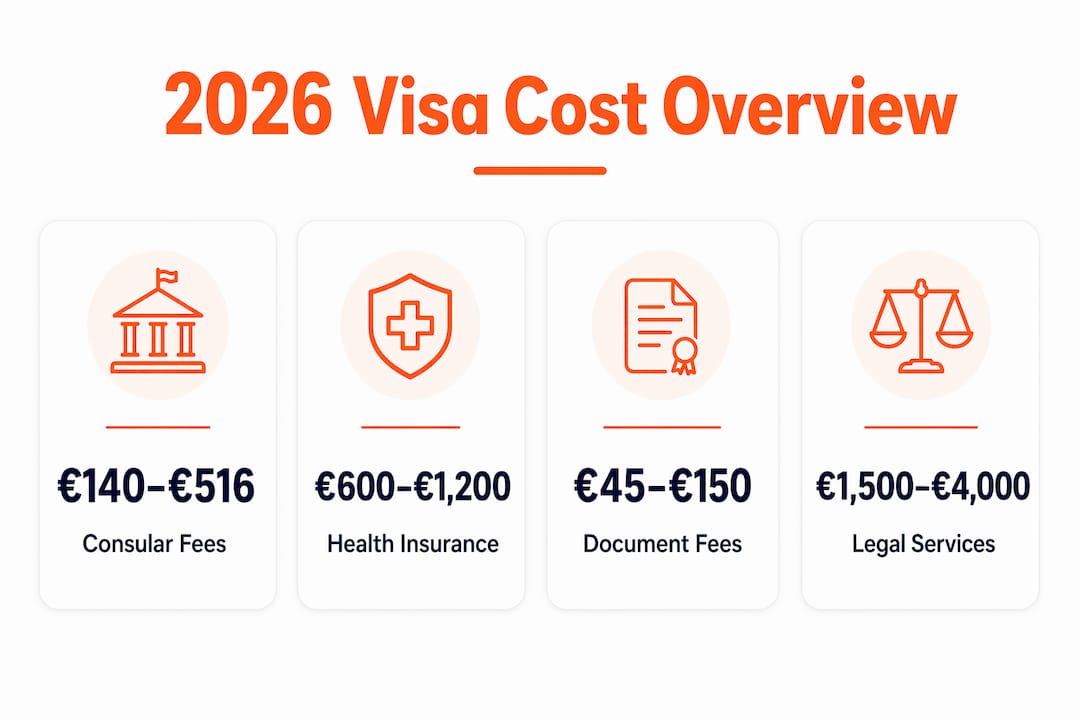
Families face a steeper bill. When you add multiple insurance policies, additional document sets, and professional legal support, family application budgets commonly reach €15,000–€30,000 for the first year.
Estimated cost ranges by applicant type:
| Cost Category | Single Applicant | Family of Four |
|---|---|---|
| Consular visa fees | $140–£516 | Multiplied per adult |
| Health insurance | €720–€4,200 | €2,880–€16,800 |
| Document preparation | €400–€900 | €800–€1,800 |
| Legal/consultant fees | €0–€4,000 | €1,500–€4,000 |
| TIE card and admin | Under €100 | Under €400 |
Variable factors that push costs higher include the number of documents requiring apostille, the age of each applicant (which drives insurance premiums), and whether you hire full legal support. Budget a 15–20% buffer above your calculated total for unexpected expenses such as reissued documents, courier fees, or consulate-specific requirements.
Pro Tip: Compare at least three Spanish-authorized health insurers before committing. Premiums for identical coverage can vary by €300–€600 annually, and that difference compounds across multiple family members.
Key Takeaways
The non-lucrative visa Spain cost is predictable when you understand all five expense categories and plan your financial documentation well ahead of your application date.
| Point | Details |
|---|---|
| Legal income minimum | €28,800 per year for one applicant, plus €7,200 per dependent, based on 400% of IPREM. |
| Consulates prefer more | Showing €60,000–€100,000 in stable savings over 6–12 months significantly reduces refusal risk. |
| Insurance is age-driven | Annual premiums range €720–€4,200 and must cover a no-copay, no-deductible Spanish policy. |
| Document costs stack up | Apostilles (€15–€35), translations (€30–€80), and background checks add €400–€900 per applicant. |
| Total first-year budget | Singles typically spend €2,500–€5,000; families with professional support budget €15,000–€30,000. |
What I’ve learned from watching applicants budget for this visa
Every year, I see the same pattern. Applicants research the legal minimum income requirement, confirm they meet it, and then submit an application that gets refused because the consulate wanted to see a stronger financial picture. The gap between “legally eligible” and “competitively positioned” is real, and it costs people months of time and thousands of euros in reapplication costs.
The second most common mistake is underestimating how long document preparation actually takes. An FBI background check by mail takes 8–12 weeks. Apostille processing in some US states runs three to four weeks. Sworn translations need a certified translator, not a bilingual friend. When you stack these timelines, a realistic preparation window is four to five months, not the six weeks most people assume.
My honest advice: treat the financial proof requirement as a 12-month project, not a 12-week one. Start building your Spanish bank account balance now. Keep your income sources clean and documented. And do not cut corners on health insurance. A noncompliant policy wastes the entire application fee and forces you to restart.
The applicants who succeed are the ones who treat this as a financial planning exercise first and a paperwork exercise second. Get the money right, then get the documents right. That order matters.
— Joshua
How Digitalnomadinspain can help with your application
Pulling together the financial proof, insurance, apostilles, translations, and consulate-specific requirements for a non-lucrative visa is a significant undertaking. Digitalnomadinspain handles the full process for applicants from over 50 countries, with a 98% approval rate and processing times that run roughly 30% faster than self-managed applications.

The team reviews your financial documentation, identifies gaps before submission, sources compliant health insurance options, and manages all document preparation on your behalf. If you want expert guidance on your specific situation, the non-lucrative visa service page covers exactly what is included. You can also book a consultation directly to get a personalized cost estimate and application plan built around your circumstances.
FAQ
How much does the non-lucrative visa cost in total?
Total first-year costs for a single applicant typically range €2,500–€5,000, covering consular fees, health insurance, and document preparation. Families using professional legal support commonly budget €15,000–€30,000.
What income do I need to prove for the non-lucrative visa?
The legal minimum is €28,800 per year for the main applicant, plus €7,200 per dependent, based on 400% of Spain’s IPREM. Consulates favor applicants who show €60,000–€100,000 in stable savings held over 6–12 months.
Does spending time outside Spain affect my visa renewal?
Spending 183 or more days per year in Spain is required to maintain residency status and meet tax compliance obligations. Extended absences can jeopardize renewal eligibility.
Can I work in Spain on a non-lucrative visa?
No. The non-lucrative visa explicitly prohibits working for Spanish employers or clients. Applicants must fund their stay entirely from passive income, savings, pensions, or foreign-sourced income. For remote workers with active income, the digital nomad visa is the appropriate alternative.
How far in advance should I start preparing my application?
Allow at least 3–4 months for full document preparation, accounting for background check processing, apostille stamps, and sworn translations. Starting earlier reduces the risk of incomplete files and missed consulate appointment slots.