
Discover the Spain non lucrative visa for US citizens in 2026. Learn about requirements and tips for a smooth application process.
The Spain Non-Lucrative Visa (NLV) is the legal pathway that lets US citizens reside in Spain long-term without working, provided they prove sufficient passive income and meet strict consulate documentation requirements. Known formally as the “Visado de Residencia No Lucrativa,” this visa suits retirees, FIRE movement members, and anyone living off investments, pensions, or Social Security. It does not permit any professional activity, including remote work for American employers. Understanding the income thresholds, FBI background check requirements, and post-arrival registration steps is the difference between a smooth approval and a costly delay.
What income and financial requirements must US applicants meet?
The 2026 financial threshold for the Non-Lucrative Visa is €28,800 per year for the main applicant, calculated at 400% of Spain’s IPREM benchmark. Each dependent family member adds €7,200 per year to that requirement. These are not suggestions. Spanish consulates treat them as hard minimums.
Qualifying income sources for the non lucrative visa application Spain include:
- Social Security benefits: Monthly statements showing consistent deposits work well.
- Pension distributions: Both private and government pensions qualify with official award letters.
- 401(k) or IRA withdrawals: Scheduled distributions count, but lump-sum savings alone carry less weight.
- Dividend and investment income: Brokerage statements showing recurring quarterly or annual payments.
- Rental income: Lease agreements and bank statements showing regular deposits.
- Savings accounts: High balances can supplement income proof but rarely stand alone.
Consulates scrutinize recurring income over one-time deposits. A bank account showing $200,000 with no regular inflow raises red flags. A combination of monthly Social Security payments plus dividend income, supported by 6 months of bank statements, is far stronger.
Currency conversion matters more than most applicants expect. The euro-to-dollar exchange rate shifts constantly, so calculate your income in euros at the time of application. Build in a buffer of at least 10–15% above the minimum to account for rate fluctuations between document preparation and the consulate appointment.
One critical detail that catches applicants off guard: some consulates calculate income requirements using 14 payment months instead of 12. That raises the effective minimum. Confirm the calculation method with your specific consulate before submitting documents.
Pro Tip: Present a combination of recurring income and a healthy savings balance. Consulates want to see that you can sustain yourself in Spain without financial stress, not just that you technically clear the minimum threshold.

What is the step-by-step application process for US citizens?
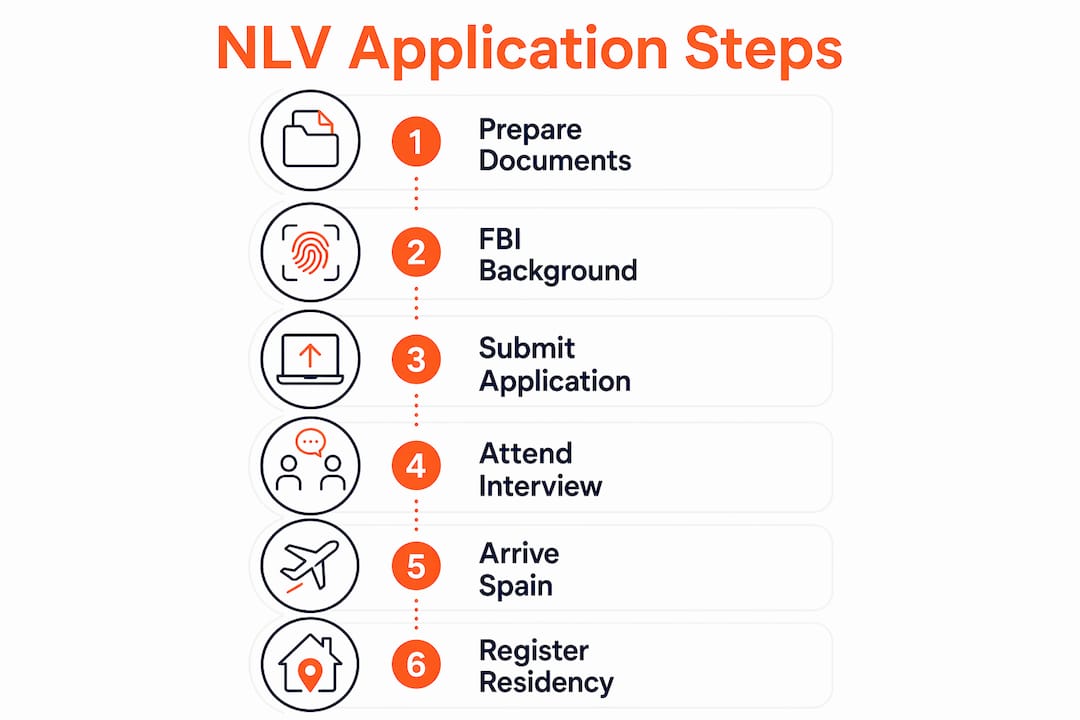
The full NLV application process for US citizens spans 5 to 7 months from start to finish. The FBI background check and consulate appointment wait times drive most of that timeline. Start both as early as possible.
- Request your FBI Identity History Summary Check. Submit fingerprints through the FBI’s official channel. Processing takes 6–10 weeks. This is the single biggest bottleneck in the entire process.
- Apostille the FBI report at the federal level. The FBI check must be apostilled by the US Department of State. State or local police clearances are rejected by Spanish consulates without exception.
- Apostille state-issued documents. Birth certificates, marriage certificates, and any other state documents need apostilles from the relevant state authority, not the federal government.
- Arrange sworn translations. All documents not in Spanish require certified translation by an official translator accredited by Spain’s Ministry of Foreign Affairs (MAEC). Standard notarized translations from US notaries are not accepted.
- Gather your full document package. The standard checklist includes: valid US passport, completed national visa application form, two recent passport photos, proof of income (bank statements, pension letters, brokerage statements), private health insurance policy covering Spain with no copays, and proof of accommodation in Spain.
- Identify your consulate jurisdiction. Spain operates 8 consulates across the US, located in Boston, Chicago, Houston, Los Angeles, Miami, New York, San Francisco, and Washington DC. You must apply at the consulate covering your state of residence.
- Book your consulate appointment. Wait times range from 2 weeks to 3 months depending on the consulate and season. Los Angeles and New York tend to have the longest waits.
- Attend the appointment and submit documents. The consulate reviews your file and issues a decision, typically within 1–3 months of submission.
Pro Tip: Start your FBI fingerprint request and apostille process the same week you decide to apply. These two steps alone can consume 3 months. Everything else can run in parallel.
How do you complete residency registration after arriving in Spain?
Arriving in Spain with your visa is not the finish line. Several legal steps must happen within strict deadlines after you land.
The first task is registering at your local town hall, known as empadronamiento. This registration proves your address in Spain and unlocks access to public services. Most town halls process it within a few days. Bring your passport, visa, and proof of your Spanish address.
The second and more critical step is applying for your TIE card (Tarjeta de Identidad de Extranjero), the physical residency card that serves as your official ID in Spain. You must apply within 30 days of arrival at the National Police office. The card itself takes 30–60 days to issue after your appointment. For detailed guidance on this process, the TIE card application guide from Digitalnomadinspain covers every step.
Practical realities of the post-arrival period include:
- Opening a Spanish bank account requires your NIE number (tax identification number), which you get during the TIE process. Without a Spanish account, signing a long-term lease is nearly impossible.
- Landlords require proof of a Spanish bank account and often a NIE before signing a lease. This creates a chicken-and-egg situation for new arrivals.
- Budget for temporary housing. Short-term rentals or furnished apartments for 1–3 months give you time to complete registrations before committing to a long-term lease. Immigrants should budget for this transition period as a standard part of relocation costs.
What are the renewal rules and tax obligations for NLV holders?
The Non-Lucrative Visa follows a structured renewal path toward permanent residency. The initial visa covers one year. After that, you can renew for two consecutive 2-year periods. After 5 years of continuous legal residence, you become eligible for permanent residency. Spanish citizenship becomes available after 10 years, though it currently requires renouncing US citizenship.
Financial requirements for renewal are higher than the initial application. Consulates expect your income to have grown, and they review your full financial picture again at each renewal. Maintaining income well above the minimum threshold protects your renewal prospects.
Tax obligations for Americans living in Spain are genuinely complex:
- US federal taxes: The US taxes citizens on worldwide income regardless of where they live. You must file a federal return every year.
- FBAR filing: Foreign bank accounts over $10,000 require annual FBAR (FinCEN Form 114) reporting.
- FATCA: If your foreign financial assets exceed $200,000 as a single filer, Form 8938 is required.
- Spanish tax residency: Spain considers you a tax resident after 183 days in the country in a calendar year. At that point, Spain taxes your worldwide income too.
- US-Spain tax treaty: The bilateral tax treaty reduces double taxation, but it does not eliminate all overlap. A tax professional who handles US expat returns is not optional at this stage.
Working while on the Non-Lucrative Visa is a legal violation. This includes freelance work, consulting, and remote employment for US companies. Violations can result in visa cancellation and a ban from reapplying. If you earn active income, the Digital Nomad Visa is the correct path.
How does the NLV compare to the Digital Nomad Visa for US citizens?
The core distinction is income type. The NLV prohibits all work, including remote work for US employers. The Digital Nomad Visa (DNV) is built specifically for people who earn active income remotely.
| Feature | Non-Lucrative Visa | Digital Nomad Visa |
|---|---|---|
| Work permitted | No | Yes (remote only) |
| Income type | Passive only | Active remote income |
| Tax regime | Standard Spanish rates | Optional Beckham Law flat rate |
| Best for | Retirees, investors | Remote workers, freelancers |
| Income threshold | €28,800/year (2026) | Higher active income threshold |
The tax difference is significant. DNV holders can elect Spain’s Beckham Law regime, which taxes Spanish-source income at a flat 24% for up to 6 years. NLV holders pay standard progressive Spanish rates once they become tax residents. For someone with substantial passive income, the NLV’s tax treatment can be less favorable than it first appears.
Applying for the wrong visa is one of the most common and expensive mistakes US applicants make. A denial wastes months of preparation and consulate fees. Before applying, read the NLV vs Digital Nomad Visa comparison from Digitalnomadinspain to confirm which path fits your income structure.
Pro Tip: If you do any freelance work, consulting, or side income from active sources, the NLV is the wrong visa. Apply for the DNV instead. Consulates do check.
Key Takeaways
The Spain Non-Lucrative Visa requires US citizens to prove at least €28,800 in annual passive income, complete FBI background checks with federal apostilles, and register for a TIE card within 30 days of arrival.
| Point | Details |
|---|---|
| Income threshold | €28,800/year for the main applicant, plus €7,200 per dependent, based on 400% IPREM. |
| FBI check timing | Start the FBI Identity History Summary Check immediately; it takes 6–10 weeks and is the main bottleneck. |
| Consulate jurisdiction | Apply at one of 8 Spanish consulates based on your US state of residence. |
| Post-arrival deadline | Apply for your TIE card within 30 days of arriving in Spain; processing takes 30–60 days. |
| Tax obligations | US citizens must file federal returns and FBAR annually, even while living in Spain full-time. |
What I’ve learned from watching Americans apply for the NLV
The applicants who struggle most are the ones who underestimate the FBI background check. I’ve seen people plan their entire move around a 4-month timeline, only to discover the FBI check alone consumed 10 weeks. By the time they added the federal apostille and consulate wait, they were looking at 7 months minimum. Start that fingerprint request before you do anything else.
The tax situation surprises almost everyone. Americans assume that moving abroad simplifies their tax life. It does the opposite. You now have two countries watching your income, and the US-Spain tax treaty, while helpful, does not eliminate the need for a specialist. Budget for a US expat tax advisor from day one. It costs less than the penalties for getting it wrong.
The visa type question is where I see the most costly errors. Someone with a small consulting side project applies for the NLV because the income requirements look easier to meet. The consulate denies them. They lose the application fee, the translation costs, and months of time. The 2026 cost breakdown for the NLV is real money. Spending it on the wrong visa is a painful lesson.
Spain’s appeal to American retirees and the FIRE community is genuine and growing. The cost of living, healthcare quality, and climate make it one of the most practical destinations for long-term residency. But the paperwork is unforgiving. The applicants who succeed treat it like a project with a timeline, a checklist, and professional support where needed.
— Joshua
How Digitalnomadinspain helps US citizens with the NLV application
Applying for the Non-Lucrative Visa involves more moving parts than most people expect, especially for US citizens dealing with FBI checks, federal apostilles, and MAEC-accredited translations.
Digitalnomadinspain handles the full application process, from checking your eligibility and preparing your document package to booking consulate appointments and guiding you through post-arrival registration. The team carries a 98% approval rate and processes applications roughly 30% faster than self-applicants, specifically because they know where US-specific requirements create delays. For anyone ready to move forward, the Non-Lucrative Visa service page covers everything included in their end-to-end support. You can also check your eligibility before committing to a full application.
FAQ
What is the minimum income for the Spain Non-Lucrative Visa in 2026?
The minimum is €28,800 per year for the main applicant, based on 400% of Spain’s IPREM benchmark. Each dependent adds €7,200 per year to that requirement.
Can US citizens work remotely on the Non-Lucrative Visa?
No. The NLV prohibits all forms of work, including remote employment for US companies. Remote workers must apply for the Digital Nomad Visa instead.
How long does the NLV application take for US citizens?
The full process typically takes 5 to 7 months. The FBI Identity History Summary Check (6–10 weeks) and consulate appointment wait times (2 weeks to 3 months) drive most of that timeline.
Do US citizens still pay US taxes while living in Spain on the NLV?
Yes. The US taxes citizens on worldwide income regardless of residence. NLV holders must file federal returns annually and report foreign accounts over $10,000 via FBAR.
How long before NLV holders can apply for permanent residency in Spain?
After 5 years of continuous legal residence in Spain, NLV holders become eligible for permanent residency. Spanish citizenship is available after 10 years but currently requires renouncing US citizenship.