
Discover the Spanish TIE card, your essential guide for residency in 2026. Learn how it unlocks banking, healthcare, and more.
The Spanish TIE, formally known as the Tarjeta de Identidad de Extranjero, is the official biometric residence card that confirms the legal status of non-EU foreigners living in Spain. It contains your NIE number, a digital photo, fingerprints, and an embedded biometric chip. As of 2026, the TIE fully replaces older paper residence permits and serves as the definitive proof of legal residency for non-EU nationals staying in Spain beyond 180 days. If you are a remote worker, retiree, or student planning a long-term stay, this card is not optional. It is the document that unlocks banking, healthcare, and nearly every official interaction you will have in Spain.
What is the difference between the Spanish TIE and the NIE?
The NIE and the TIE are two distinct documents, and confusing them is one of the most common mistakes new residents make. The NIE is an identification number assigned to foreigners for tax and administrative purposes. It never expires and looks like a simple certificate printed on paper. The TIE is the physical, credit-card-sized plastic card that contains that same NIE number along with your biometric data.
Think of the NIE as your foreign tax ID and the TIE as your resident ID card. You need the NIE to buy property, open a bank account, or sign a contract. You need the TIE to prove you are legally authorized to live in Spain. Having one does not mean you have the other.

Here is how the two documents compare:
| Feature | NIE | TIE |
|---|---|---|
| Format | Paper certificate | Biometric plastic card |
| Contains biometric data | No | Yes (photo, fingerprints, chip) |
| Expiration | Never expires | Tied to residence permit length |
| Proves residency | No | Yes |
| Used for taxes and contracts | Yes | Yes |
| Required for banking | Often accepted | Preferred or required |
The residence permit is the right to live in Spain. The TIE card is the physical document proving that right. Holding a valid residence permit does not automatically mean you possess the TIE card. You must apply for the card separately after your permit is approved.
Pro Tip: Keep both your NIE certificate and your TIE card in a safe place. Some older institutions still ask for the paper NIE, while government offices and banks increasingly require the TIE.
Who needs a Spanish TIE card?
The TIE requirement applies specifically to non-EU, non-EEA, and non-Swiss nationals. EU, EEA, and Swiss citizens register through a different system and receive a green registration certificate instead of a TIE. The threshold that triggers the TIE requirement is a stay of more than 180 days in Spain.
The following groups require a TIE:
- Non-EU nationals on any long-term visa, including the Digital Nomad Visa and Non-Lucrative Visa
- UK citizens post-Brexit, who no longer qualify for the EU registration system
- Students enrolled in programs lasting more than 180 days
- Family members of non-EU residents who hold their own residence authorization
The Brexit situation deserves special attention. UK nationals who arrived before Brexit and hold older green EU registration certificates are technically legal residents. However, UK citizens post-Brexit generally must upgrade from those green certificates to the biometric Brexit TIE card. The biometric card is far more widely recognized by banks, car rental companies, and government offices.
Students often overlook the TIE requirement. If your language course or university program runs beyond 180 days, you need to apply. The fingerprinting appointment is the pivotal bureaucratic step and is required regardless of your visa category.
Pro Tip: If you hold a Digital Nomad Visa or Non-Lucrative Visa, your TIE application is a separate step from the visa approval itself. Do not assume the visa process covers the card. Check your visa eligibility before you travel so you know exactly what to expect on arrival.
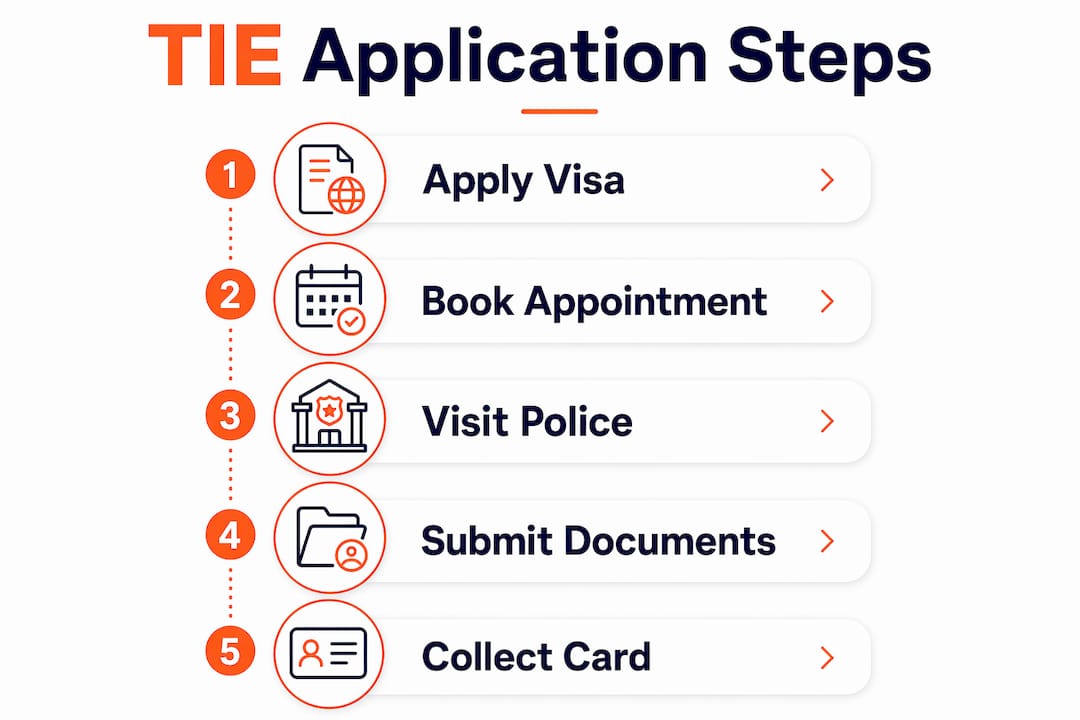
How to apply for a Spanish TIE: step by step
The application process follows a clear sequence, though the scheduling step is where most people hit friction.
-
Confirm your visa approval. Your TIE application can only begin after your residence permit or visa is granted. The permit is the legal authorization; the TIE is the card that proves it.
-
Book your fingerprinting appointment (toma de huellas). This appointment is made through the Spanish National Police website or in person at a police station. Applicants must apply within 30 days of arrival, but appointment slots are often scarce. Booking immediately after your visa is approved is critical.
-
Prepare your documents. You will typically need your valid passport, two recent passport-sized photos, proof of your residence permit approval, the completed application form (EX-17), and proof of payment of the administrative fee (Modelo 790 Código 012).
-
Attend the fingerprinting appointment. A police officer takes your fingerprints and verifies your documents. This step cannot be skipped or delegated.
-
Return to collect your card. Processing times vary by city and police station. Madrid and Barcelona tend to have longer waits than smaller cities. You will receive a notification or a collection date when your card is ready.
-
Renew before expiration. The TIE card’s validity correlates directly to the length of your residence permit, typically ranging from 1 to 5 years. Expired cards must be renewed to maintain legal residency proof.
The 30-day deadline sounds strict, but Spanish authorities show flexibility around initial applications during appointment shortages if applicants demonstrate good faith efforts. Keeping timestamped screenshots of your booking attempts is the practical way to show that effort. A detailed guide on booking your fingerprint appointment can help you avoid the most common scheduling mistakes.
Pro Tip: Screenshot every booking attempt with the date and time visible. If authorities question your timeline, that evidence protects you from penalties during the appointment backlog.
What can you do with a Spanish TIE card?
The TIE card is not just a bureaucratic formality. It is the document that makes daily life in Spain function smoothly for non-EU residents.
Banks and government offices typically require the TIE for identity verification and proof of residence. Opening a Spanish bank account as an expat is significantly easier when you present a TIE rather than a paper NIE certificate. The card carries biometric data that banks trust as a verification standard. The role of the TIE in banking is one of the most practical reasons to prioritize getting it early.
Beyond banking, the TIE enables the following:
- Healthcare registration: Registering with the Spanish public health system (Sistema Nacional de Salud) requires proof of legal residence. The TIE is the accepted document.
- Employment verification: Employers must confirm a worker’s legal authorization to work. The TIE provides that confirmation instantly.
- Travel within Spain: While your passport is always valid for travel, the TIE functions as a recognized identity document at domestic checkpoints and for car rentals.
- Digital Nomad Visa holders: Those on the Digital Nomad Visa receive a TIE that reflects their specific residency category, which is relevant when dealing with tax authorities and professional clients.
- Administrative tasks: Signing leases, registering with the local municipality (empadronamiento), and accessing government portals all go faster with a TIE in hand.
The card also simplifies interactions with Spanish authorities. Police, border agents, and local officials recognize the TIE immediately. Presenting a paper NIE certificate in the same situations often leads to delays and additional questions.
Key Takeaways
The Spanish TIE is the single most important document for non-EU residents in Spain, and getting it right from the start prevents significant administrative problems down the line.
| Point | Details |
|---|---|
| TIE vs. NIE distinction | The NIE is a number; the TIE is the physical biometric card that contains it and proves residency. |
| Who needs it | Non-EU nationals staying over 180 days, including UK citizens post-Brexit, students, and visa holders. |
| Application deadline | Apply within 30 days of arrival; book the fingerprinting appointment immediately to avoid delays. |
| Practical value | The TIE unlocks banking, healthcare, employment verification, and most official administrative tasks. |
| Renewal requirement | The card expires with your residence permit and must be renewed to maintain legal residency proof. |
What I have learned from watching people navigate the TIE process
The TIE appointment shortage is the part nobody warns you about clearly enough. I have seen people arrive in Spain with their visa approved, feeling organized and prepared, only to spend weeks trying to book a fingerprinting slot. The official 30-day deadline creates real anxiety when the booking system shows no availability for two months.
The practical answer is to start booking the moment your visa is approved, not after you land. Screenshot every failed attempt. Spanish authorities do show flexibility when you can demonstrate you tried. That flexibility is not guaranteed, but it is real and widely observed.
The Brexit TIE upgrade is another area where I see people underestimate the friction of staying on the old green certificate. Upgrading to the biometric Brexit TIE reduces daily friction in services like banking and car rentals in ways that are hard to appreciate until you are standing at a rental counter being told your green certificate is not accepted. The biometric card is simply more trusted across the board.
My honest advice: treat the TIE application as part of your arrival checklist, not an afterthought. The card is what makes your residency real in practical terms.
— Joshua
How Digitalnomadinspain supports your TIE application
Getting your TIE card right the first time matters. Digitalnomadinspain works with clients from over 50 countries to manage the full residency process, from visa approval through TIE card application and fingerprinting appointments.

Whether you are applying for the Digital Nomad Visa or the Non-Lucrative Visa, the team at Digitalnomadinspain handles document preparation, appointment coordination, and personalized guidance at every step. With a 98% success rate and processing times typically 30% faster than self-applicants, the service is built for people who want their Spanish residency handled correctly. Book a consultation to get expert support tailored to your situation.
FAQ
What is the Spanish TIE card?
The Spanish TIE (Tarjeta de Identidad de Extranjero) is the biometric residence card issued to non-EU nationals living in Spain for more than 180 days. It contains your NIE number, photo, fingerprints, and a biometric chip confirming your legal residency status.
How long does it take to get a TIE card in Spain?
Processing times vary by city and police station, but the fingerprinting appointment is often the longest wait. Booking immediately after visa approval is the most effective way to avoid delays.
Does the TIE card expire?
Yes. The TIE card’s validity matches the length of your residence permit, typically ranging from 1 to 5 years. You must renew it before it expires to maintain valid proof of legal residency.
Do UK citizens need a TIE card after Brexit?
Yes. UK nationals living in Spain post-Brexit must obtain the biometric Brexit TIE card. Older green EU registration certificates are no longer sufficient for most banking and administrative purposes.
What happens if I miss the 30-day TIE application deadline?
Spanish authorities generally show flexibility if you can prove you attempted to book an appointment within the deadline. Keeping timestamped screenshots of your booking attempts is the recommended way to document your good faith efforts.