
Clear rules for Spain sponsor affidavits: the six required elements, consulate notarization needs, and how to avoid bank statement rejections.
Pass Consulate Checks: 6 Affidavit Elements for a Spain Visa

Yes, most long-term Spain visas that rely on a sponsor require an affidavit of support, while short-term Schengen tourist visas typically use a Carta de Invitación instead. The document creates a binding pledge that the sponsor will cover the applicant’s living costs, housing, and insurance for a defined period. Consulates check it alongside recent bank statements and sponsor identification before accepting any application.
TL;DR:
- Most sponsorship affidavits require detailed identification, clear commitments, and matching proof documents, with validation including notarization or apostille depending on the consulate.
- Official bank statements are essential for proving financial capacity, and screenshots or vague letters often lead to rejection, especially when deposits lack explanation.
- Each consulate can have different requirements for notarization, translations, and supporting documents, making personalized guidance crucial before submission.
- Applicants with insufficient personal funds can use scholarships, grants, or proof of independent income through remote work as alternatives to affidavits.
- Starting preparations early, verifying documents against specific consulate checklists, and seeking professional review significantly reduce rejection risks and processing delays.
Table of Contents
- When Do You Need an Affidavit of Support for a Spain Visa?
- What Must an Affidavit of Support Include?
- What Documents Prove the Sponsor Can Pay?
- Do You Need Notarization or an Apostille?
- Common Mistakes That Get Affidavits Rejected
- How Do You Submit the Affidavit, and How Long Does Approval Take?
- Why Professional Document Review Cuts Rejection Risk
- What Are the Income Thresholds for Different Visa Types?
- What If a Sponsor Can’t Provide an Affidavit?
- What Legal Responsibilities Does the Sponsor Take On?
- What Actually Gets Applications Approved
- Get Your Affidavit and Documents Reviewed Before You Submit
- Sources
- FAQ
When Do You Need an Affidavit of Support for a Spain Visa?
Consulates ask for a sponsor’s written commitment on specific visa categories, not every application. Student visas frequently rely on a sponsorship declaration, sometimes called a carta de patrocinio when the applicant can’t show independent funds. Non-lucrative visa applicants sometimes bring in a family member’s affidavit if their own savings fall short of the threshold, and certain family reunification procedures ask for a similar pledge from the resident relative.
Short-stay Schengen tourist visas work differently. Those typically use a Carta de Invitación, a separate document a host registers with local police, not a financial affidavit. The distinction trips up a lot of applicants who assume one document covers both scenarios.
- Student visas: sponsorship declaration common when funds are insufficient independently
- Non-lucrative visas: family or third-party affidavit accepted when the applicant’s own resources are borderline
- Family reunification: resident sponsor may need to prove ability to support relatives
- Tourist visas: usually Carta de Invitación, not an affidavit
Every consulate runs its own version of this checklist, and Madrid’s requirements won’t always match what a BLS center in another country asks for. Before you draft anything, pull the Ministerio de Asuntos Exteriores guidance for your destination or check the specific consulate/BLS PDF, since that document overrides generic advice every time.
What Must an Affidavit of Support Include?
An affidavit that passes review reads like a contract, not a friendly note. The Spanish Ministry of Foreign Affairs is explicit that the document must name the sponsor, state the relationship to the applicant, spell out the commitment, and be backed by proof of solvency. Vague language is the fastest way to get flagged for additional evidence.
Build the affidavit around these elements:
- Sponsor identification — full legal name, nationality, passport or ID number, home address, and contact details.
- Sponsored person’s details — full name, passport number, and the exact nature of the relationship (parent, spouse, sibling, or unrelated sponsor).
- The pledge itself — precise wording on what’s covered: monthly maintenance, tuition, accommodation, health insurance, stated as amounts where possible.
- Duration or exact dates — how long the commitment runs, tied to the length of the visa or academic program.
- Signature, date, and place — signed in ink, notarized if the destination consulate requires it.
- Annexes — bank statements, payslips or tax returns, proof of relationship, and certified translations or an apostille when the originals aren’t in Spanish or don’t come from Spain.
Some BLS centers publish sample sponsor-letter PDFs that show acceptable phrasing and annex order, which is worth reviewing before you write your own draft.
Pro Tip: Match every promise in the affidavit to a specific attached document. If you write “I will cover tuition of $12,000,” attach the bank statement or employer letter that proves you actually have that capacity. A pledge without matching proof reads as unsupported.
What Documents Prove the Sponsor Can Pay?
Bank statements do most of the heavy lifting here. Consulates want official, stamped statements or bank-letterhead PDFs, not screenshots from a mobile app. The Interlink Agency’s guidance on student visa financial requirements notes that consulates commonly ask for 3 to 12 months of history, with student and non-lucrative applications often require longer banking history documentation.
Beyond the bank records, expect to assemble:
- Payslips, an employer letter, or tax returns if the sponsor is self-employed
- Certified Spanish translations for any document not already in Spanish
- Birth or marriage certificates when the sponsorship rests on a family relationship
- Source documents for large or recent deposits: a signed sale agreement, a gift letter, or loan paperwork
That last point matters more than applicants expect. A sudden large recent deposit that shows up two weeks before the appointment, with no explanation attached, is one of the more common triggers for a consular request for further evidence. If you can get bank statements verified in the format Spanish consulates accept, you avoid the back-and-forth entirely.
Do You Need Notarization or an Apostille?
It depends entirely on the consulate, and this is where a lot of otherwise solid affidavits get stuck. Some consulates accept a private sponsor letter with a simple signature. Others insist on a notary clause before they’ll even log the application, and the non-lucrative visa checklist from the Spanish Consulate in Edinburgh confirms that notarization, apostille, and sworn translations are standard asks depending on where the documents originate.
If a document was issued outside Spain and needs to be used there officially, it usually needs a Hague apostille plus a sworn Spanish translation. Before you notarize anything, check the destination consulate’s own checklist or the Ministry of Foreign Affairs page, since some consulates want the apostille on the original document and others want it on the translation.
- Confirm whether your specific consulate requires notarization on the affidavit itself
- Check whether source documents need an apostille before translation
- Use a certified or sworn translator recognized by the consulate, not a generic translation service
Common Mistakes That Get Affidavits Rejected
Most denials trace back to a handful of avoidable errors. Screenshots of bank apps are a recurring one. Consular staff want official statements with a bank header or a stamped printed copy, not a phone screenshot that anyone could edit.
Unsigned or vaguely worded letters cause similar trouble. “I will help support my daughter” doesn’t tell a consular officer anything concrete. Write the exact obligation, sign it in ink, and date it. Unusual bank movements are another flag. If a large deposit lands right before your appointment, attach the sale agreement, gift letter, or loan document immediately rather than waiting for someone to ask.
- Submit official bank statements, never screenshots
- Use specific, signed, dated commitment language
- Explain large deposits with provenance documents upfront
- Follow your consulate’s actual checklist instead of a generic template found online
Pro Tip: If your consulate’s checklist and a template you found online disagree, the checklist wins every time. Templates are a starting point, not the final word.
How Do You Submit the Affidavit, and How Long Does Approval Take?
Bring originals and copies to your visa appointment unless your consulate’s checklist explicitly says otherwise. Some accept certified copies; most want to see the original at least once. Standard legal decision periods run around a standard decision period of about two to three weeks for many national visas, according to consulate general-information pages, though that window extends if the consulate requests more documents or schedules an interview.
- Confirm the final document list against your consulate’s checklist a week before your appointment.
- Verify notarization and apostille steps are complete, not pending.
- Have certified translations ready and matched to their original documents.
- If the consulate requests additional evidence, respond quickly with the exact document asked for, not a broader packet.
Why Professional Document Review Cuts Rejection Risk
An affidavit can look complete and still miss what a specific consulate wants. That’s where document review earns its cost. Some professional visa consultants work through bank statement vetting, notarization and apostille coordination, and certified translation handling as part of their application support.
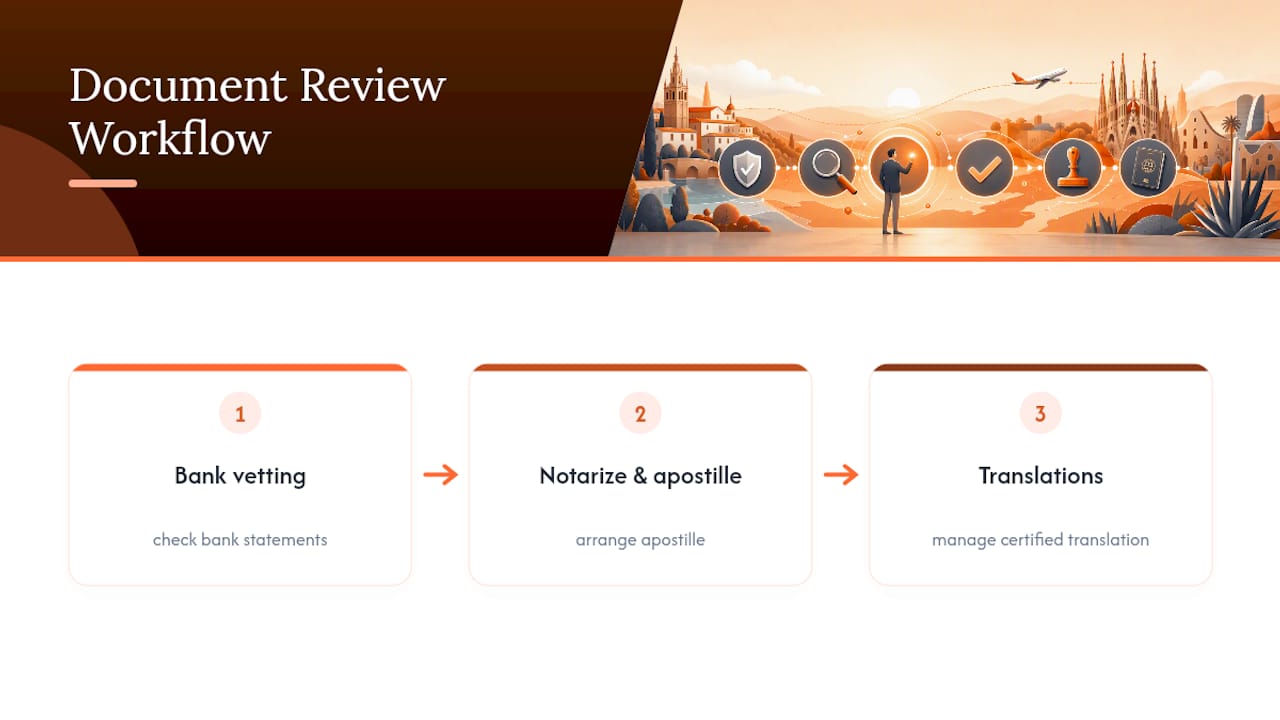
The firm reports a a very high success rate and processing roughly 30% faster than self-applicants, attributed to catching consulate-specific formatting issues before submission. A paid review makes the most sense when finances sit close to the threshold, when a bank account shows unexplained large deposits, or when the destination consulate has unusual notarization demands that generic guides don’t cover.
What Are the Income Thresholds for Different Visa Types?
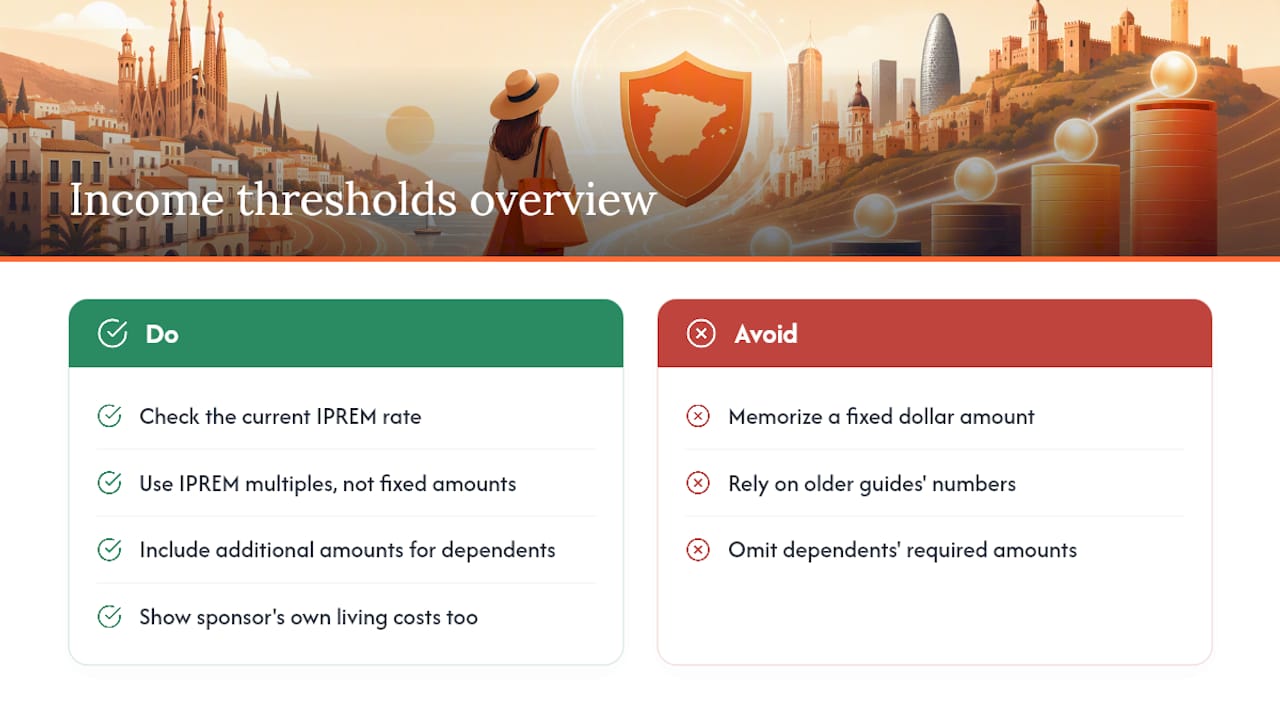
Financial thresholds vary by visa category, and none of them are flat numbers you can memorize once and forget. Student visa sponsorship, according to Interlink Agency’s breakdown, ties financial requirements to IPREM, Spain’s public income indicator used across immigration and benefits law. Rather than a fixed dollar figure, requirements are expressed as multiples of IPREM, which the Spanish government adjusts periodically.
Non-lucrative visa applicants face a similar structure: the government requires proof of means calculated as a multiple of IPREM per applicant, with additional amounts for dependents included on the same application. Because IPREM changes, the safest approach is to check the current published rate through your consulate’s checklist rather than relying on a number from an older guide. For a full breakdown of how these figures translate into required bank balances, Digital Nomad in Spain’s guide to non-lucrative visa income requirements walks through the calculation.
Sponsors backing a student or family member need to show they meet the threshold on top of their own living costs, not instead of them. A consulate reviewing a sponsor’s bank statement wants to see enough left over to support the sponsor’s own household after the pledged amount is set aside.
What If a Sponsor Can’t Provide an Affidavit?
Not every applicant has someone able to sign a financial pledge, and that doesn’t automatically end the application. The most common alternative is proving independent means directly. Non-lucrative applicants can show their own savings or passive income meet the IPREM-based threshold without any third-party involvement.
For remote workers and freelancers, the Digital Nomad Visa route sidesteps the sponsorship question entirely by requiring proof of stable income from clients or an employer outside Spain, rather than a guarantor’s pledge. A detailed non-lucrative visa application guide covers how to document independent income when no sponsor is involved.
Other paths include combining partial sponsorship with the applicant’s own savings, where the affidavit covers a specific cost (tuition, for instance) while the applicant demonstrates funds for the rest. A scholarship or grant letter can sometimes substitute for part of the financial proof on student visas, though consulates vary on how much weight they give this. If you’re relocating for tax and financial planning reasons beyond the visa itself, this guide to moving to Spain covers visas and broader financial life as an American relocating abroad.
What Legal Responsibilities Does the Sponsor Take On?
Signing an affidavit isn’t a formality. Consular officers treat it as evidence of a genuine legal obligation, not a polite gesture of support. Once signed and submitted, the sponsor has represented to a government agency that they will cover specific costs for a specific period, and that representation can carry consequences if it turns out to be false or unsupported.
The practical liability is financial and reputational rather than automatically criminal. A sponsor who signs an affidavit without the means to back it up risks the application being rejected outright, and in cases of clear misrepresentation, future visa sponsorship attempts can face heightened scrutiny. Sponsors should also understand the commitment doesn’t quietly expire. If the affidavit states a duration tied to the visa or program length, the sponsor is expected to maintain the ability to support the applicant through that entire window, not just at the moment of signing.
This is why consular officers weigh consistent financial history more heavily than a notarized letter on its own. A sponsor with six months of stable statements and no unexplained gaps looks far more credible than one who deposited a lump sum the week before applying.
What Actually Gets Applications Approved
Most guides treat the affidavit like a form to fill out correctly. That’s backward. The affidavit matters less than what backs it up. A consular officer isn’t grading your prose, they’re checking whether the money described in your letter actually exists and moves the way you say it does.
The overlooked variable is timing. Applicants scramble to gather bank statements in the final two weeks before an appointment, which is exactly when unexplained deposits and thin transaction histories show up. Start assembling financial proof months before you draft the affidavit itself, not after.
The other gap: people treat notarization and apostille rules as universal when they’re consulate-specific. Two applicants sponsoring nearly identical cases through different consulates can face completely different formality requirements. Chasing a template found online instead of your specific consulate’s PDF wastes more applications than a poorly worded pledge ever does.
If your finances are clean, your history is consistent, and your consulate’s checklist is followed to the letter, the affidavit is the easy part. Where readers should actually spend their effort is document consistency, months in advance, not polishing the letter’s wording the night before an appointment.
— Joshua
Get Your Affidavit and Documents Reviewed Before You Submit
A rejected application over a technicality costs more time than getting it right the first time. Professional visa consultancies may handle document preparation for certain Spain visas, including bank statement vetting, notarization and apostille coordination, and certified translation handling, helping ensure affidavits and supporting evidence match consulate expectations.

If you’re sponsoring a family member or applying with your own funds, start with the eligibility checker to see where your documentation stands. Applicants leaning on non-lucrative residency can review the Non-Lucrative Visa service page for what a full document-prep package includes, while remote workers and freelancers can check the Digital Nomad Visa page for income documentation that replaces a sponsor affidavit entirely. Book a document review before your consulate appointment, not after a request for more evidence arrives.
Sources
Consulate rules change, so verify current requirements directly through the Spanish Ministry of Foreign Affairs and your destination’s specific consulate visa checklist. Treat the consulate’s own PDF as the final word over any third-party guide, including this one.
FAQ
Do I need an affidavit of support for a tourist visa?
Usually not. Short-stay Schengen tourist visas typically rely on a Carta de Invitación from a host rather than a financial affidavit, though requirements vary by consulate.
What are common reasons for Spain visa denial?
Incomplete bank statement history, unexplained large deposits, unsigned or vague sponsorship letters, and missing notarization or translation steps are among the most frequent causes.
How long does it take for an affidavit of support to be approved?
There’s no separate approval step for the affidavit alone. It’s reviewed as part of the full visa application, which carries a typical two-to-three week decision period that can extend if the consulate requests more documents.
What are common affidavit of support mistakes?
The biggest ones are submitting bank app screenshots instead of official statements, using vague commitment language instead of specific amounts and dates, and skipping notarization when the consulate’s checklist requires it.
Can Digital Nomad in Spain help draft or review my affidavit?
Some visa consultancies offer affidavit and supporting bank documentation review services as part of application support, checking formatting against consulate-specific requirements before submission.